
Fractional CIO vs. MSP: What's the Difference — and Which One Do You Actually Need?
By Geoffrey Pope | Turning Point Advisory
If you run a company with 50 to 500 employees, you've probably heard both terms. You might even be paying for one of them right now. But when business leaders ask me whether they need a fractional CIO or a managed service provider, my first answer is almost always the same:
They're not the same thing — and confusing them is costing you.
This isn't a knock on MSPs. A good MSP is genuinely valuable. But over the course of 25+ years leading IT at organizations in healthcare, EdTech, and insurance, I've walked into dozens of mid-market companies where the MSP had been "handling IT" for years — and nobody had ever asked whether the technology was actually aligned with where the business was going.
That's the gap. And it's a significant one.
What an MSP Actually Does
A managed service provider is an outsourced IT support and operations vendor. Their job is to keep your systems running. Day to day, that means:
Monitoring your network and infrastructure for outages or threats
Managing your helpdesk — resetting passwords, fixing printer issues, resolving software problems
Patching and updating systems on a regular schedule
Managing your cybersecurity tools (firewalls, endpoint protection, backups)
Providing a team to call when something breaks
MSPs are operationally focused. They are measured on uptime, ticket resolution time, and response speed. A good MSP is the difference between a 20-minute outage and a 4-hour one. That matters enormously.
What MSPs are generally not designed to do is tell you whether your current technology stack is the right one for your next three years of growth. That's not their model, and it's not what you're paying them for.
What a Fractional CIO Actually Does
A fractional CIO is a part-time or engagement-based senior technology executive. The operative word is executive — someone who sits at or near the leadership level, understands business strategy, and translates it into technology decisions.
Day to day, a fractional CIO is doing things like:
Building a technology roadmap tied to your specific business goals for the next 12 to 36 months
Identifying where your current systems are limiting growth — and what to do about it
Managing vendor relationships, including holding your MSP accountable to deliverables
Overseeing cybersecurity posture and compliance at a strategic level
Guiding major technology decisions — ERP selection, cloud migration, new platform adoption
Representing IT in executive and board-level conversations
Conducting IT due diligence for acquisitions or fundraising events
A fractional CIO is strategically focused. They are not there to reset your passwords or monitor your firewall — but they are there to make sure the person doing those things is doing them correctly and in service of where your business is going.
The Simplest Way to Understand the Difference
Think of it this way:
Your MSP keeps the lights on. Your fractional CIO decides which rooms need lights in the first place.
Or, if you prefer a business analogy: an MSP is to IT what an accounting firm is to finance. They handle the operations and compliance of the function. A fractional CIO is to IT what a CFO is to finance — the strategic leadership that shapes the decisions.
Most mid-market companies have the accounting firm. Far fewer have the CFO equivalent on the technology side. That's the gap.
Why This Confusion Is So Common
The line between MSP and fractional CIO has blurred in recent years for a simple reason: many MSPs have started offering "virtual CIO" or "vCIO" services as an add-on to their managed services contract.
On paper, this sounds appealing. In practice, there's a structural problem.
Your MSP earns revenue by managing your current environment. Their financial incentive is to keep things stable, not to challenge your architecture or recommend a platform migration that might reduce their monthly billing. A true fractional CIO has no such conflict. They are vendor agnostic, accountable only to your business outcomes, and incentivized to recommend whatever is actually right — even if that means changing vendors.
That independence matters more than most business leaders realize until they've experienced the difference.
Signs Your Company Needs a Fractional CIO
You likely need fractional CIO support if any of the following sounds familiar:
Your IT feels reactive, not proactive. Every week is firefighting. Technology decisions get made under pressure rather than from a plan.
You have an MSP but no IT roadmap. You're paying for support, but nobody has ever asked: is this the right infrastructure for where we're going in two years?
You're making major technology decisions without senior guidance. ERP selection, cloud migration, a new HRIS — these are consequential decisions that benefit enormously from experienced leadership.
Your compliance exposure keeps you up at night. Whether it's HIPAA, SOC 2, CMMC, or another framework, compliance in regulated industries requires executive-level IT accountability — not just a checklist.
You're growing through acquisition. M&A IT due diligence is one of the most consistently underestimated risks in the deal process. A fractional CIO protects you here.
Your IT leader left — or never existed. Companies that relied on a single internal IT person are acutely vulnerable when that person moves on. A fractional CIO provides continuity and structure.
You're scaling and your technology hasn't kept up. What worked at 30 employees often breaks at 150. A fractional CIO builds the foundation for where you're going, not where you've been.
Signs Your Company Needs a Better MSP (Not a Fractional CIO)
To be balanced: sometimes the answer really is a better MSP, not a fractional CIO. This is likely the case if:
Your systems are well-architected and running smoothly
You have a clear IT roadmap and are confident in your technology decisions
Your main pain points are helpdesk response times and patching compliance
You're under 30 employees and your technology needs are genuinely simple
In these cases, the problem is operational, not strategic. A fractional CIO won't fix slow ticket resolution times — that's an MSP performance issue.
Do You Need Both?
Yes — and most of our clients have both.
A fractional CIO and an MSP are complementary, not competitive. The fractional CIO provides the strategy and executive oversight. The MSP provides the day-to-day operational support. When both are in place, the fractional CIO acts as the informed buyer and accountability layer for the MSP — reviewing their performance, holding them to SLAs, and making sure the tools they're managing are actually the right tools.
Think of it as checks and balances. Your MSP is less likely to let things slide when they know there's a senior IT leader reviewing their work. And your fractional CIO is more effective when there's a reliable operational team executing the fundamentals.
What This Looks Like at a 150-Person Company
Here's a practical example of how the two roles divide at a mid-market company:
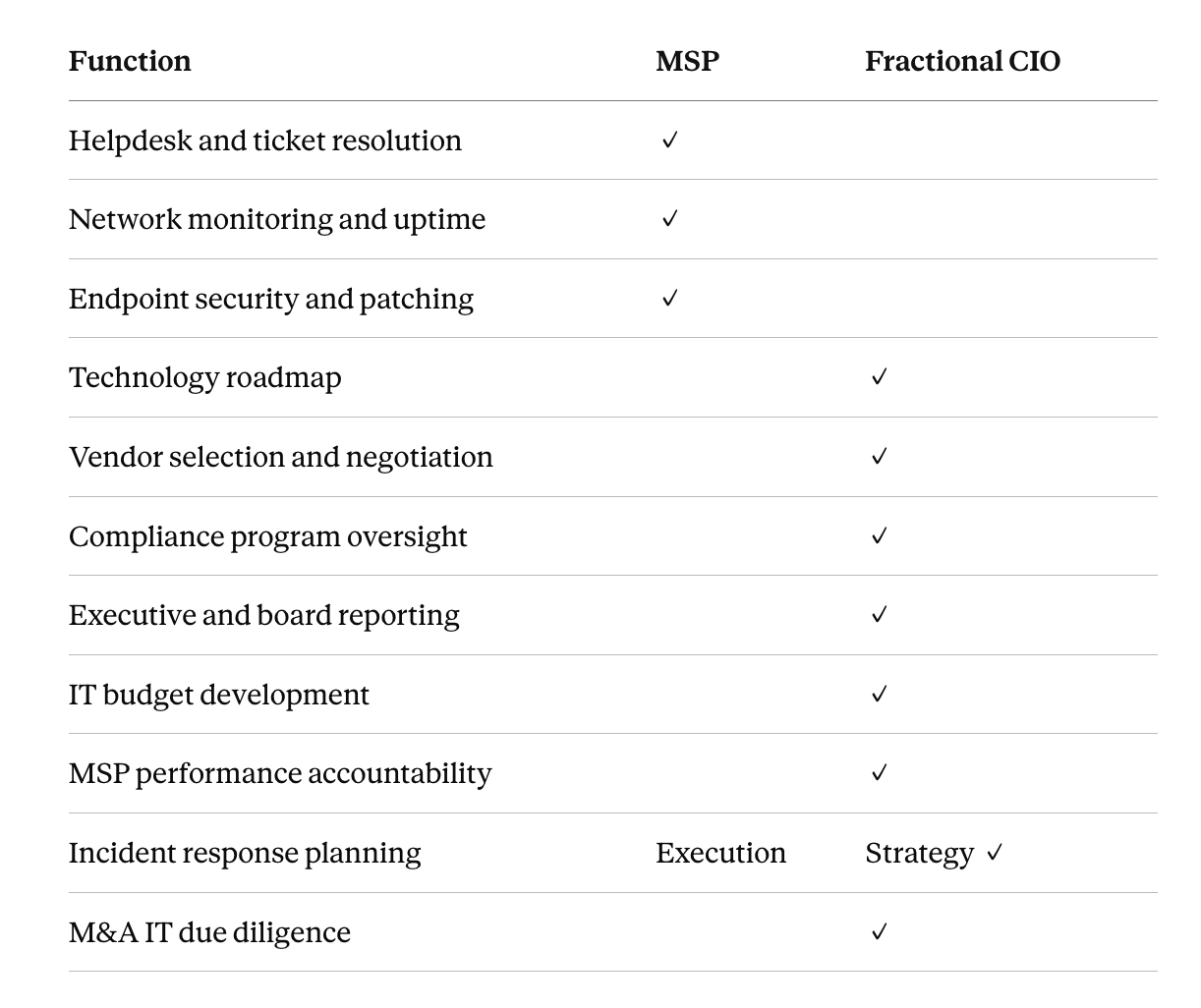
MSP & Fractional CIO Roles
The Cost Question
A full-time CIO at a mid-market company typically costs $220,000 to $280,000 per year — plus benefits, equity, and 6 to 9 months of recruiting time.
A fractional CIO engagement provides the same caliber of senior IT leadership at a fraction of that cost, scaled to the hours and scope your business actually needs. For most companies in the 50 to 500 employee range, a fractional CIO engagement runs considerably less than a single month of a full-time CIO's salary.
The question isn't whether you can afford a fractional CIO. For most mid-market companies, the better question is whether you can afford to keep making technology decisions without one.
A Final Thought
I've worked with companies that spent years paying an MSP for "vCIO services" that amounted to a quarterly check-in and a slide deck. I've also worked with companies that had a fractional CIO but no reliable operational support underneath them — which is its own problem.
The goal is the right structure for your stage of growth. Most companies between 50 and 500 employees need both: an MSP handling the operational layer and a fractional CIO providing the strategic leadership that makes sure the whole system is moving in the right direction.
If you're not sure which one you're missing — that uncertainty is usually the answer.
Geoffrey Pope is the Founder and fractional CIO at Turning Point Advisory, providing IT strategy, cybersecurity, and executive IT leadership to mid-market companies across Massachusetts, New England, and Southwest Florida. You can reach Geoff at geoff@turningpointadvisory.net or schedule a free 30-minute IT strategy conversation at turningpointadvisory.net/stay-in-touch.
